


The Quick Version
Every day, successful companies hemorrhage their most valuable asset: the context behind their decisions disappears the moment a meeting ends or an employee walks out the door.
The real power of AI is not writing faster emails, it is re-architecting the company from an open-loop model that forgets into a closed-loop one that never does.
There is a specific set of moves that turns your next meeting with leadership into the first step of that shift, and none of them require a bigger budget.
The Question Nobody Could Answer
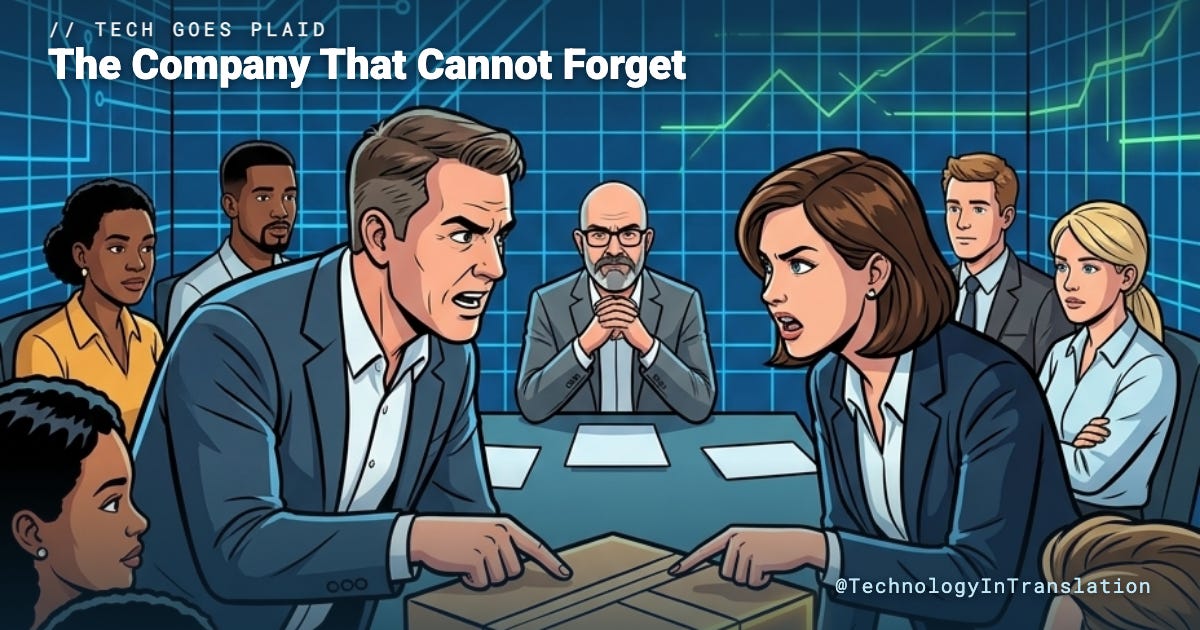
Why did we have to put shipping labels on the horizontal and vertical long surfaces of the boxes that we were shipping to the big-box retailer?
That was the question before the assembled group. This had been going on for years. Each time we added that extra label, it cost money, labor, and materials, and we shipped a lot of boxes to this retailer.
The sales manager simply knew that he’d been told by the salesperson before him that it was a must.
The warehouse ops director said it was that way when he arrived.
Spoiler Alert: We called and asked and they didn’t know either. Said it was fine if we stopped. Ohh...Years of making the same mistake over and over and costing hundreds of thousands of dollars.
Every day modern, efficient, successful companies lose incalculable amounts of data. They lose it because:
It wasn’t recorded (did Jon take notes?)
It was recorded, but in analog (where is Jon’s paper notebook?)
The institutional knowledge is gone (Jon and what he knows works for your competitor now)
It was emailed and can’t be found (Jon’s email was archived per company policy)
In corporate conference rooms, AI gets discussed as a tool for marginal productivity: a better way to write emails, a faster way to summarize reports. That is a company 10 years ago deciding its future depended on faster fax machines with bigger paper trays. The real power of AI is not making individual employees faster. It is re-architecting the company’s operating system from an open-loop model to a closed-loop one.
For any company trying to scale, this shift is the difference between stagnation and speed.
The Invisible Tax: The Open-Loop Corporation
Most companies today are lossy. Intelligence gets generated in meetings, captured in private paper notebooks that are never revisited, or buried in the email accounts of employees who eventually leave. When an executive departs or a project ends, the why behind critical decisions evaporates. CRMs help, but they track where things are now, not how they got there. An open-loop model.
This institutional amnesia is a hidden tax on productivity. It forces companies to solve the same problems over and over and keeps them from learning from their own experience. In a traditional open-loop system:
Information flows in one direction
It hits a manual gate, usually a middle manager, where it gets simplified and condensed
It gets transmitted to upper management
The feedback rarely makes it back into any systematic layer of intelligence that could improve the next cycle. So the same mistakes get made over and over.
To scale in the AI era, companies must move toward a closed-loop architecture: a system where every business process is captured and fed into an intelligence layer that is then used to self-regulate and improve outcomes.
Phase 1: Building the Queryable Organization
AI cannot improve a process it cannot see. The first step for any organization is making itself legible to the intelligence layer. That requires a shift toward public-first communication.
For decades, email has been the black box where corporate intelligence goes to die. Closed-loop companies move discussions out of private threads and into open, searchable repositories. Yes, that sounds like surveillance to the people being recorded, and leaders who ignore that will lose the room. The line that matters is who the data serves. Capturing a vendor negotiation so the next person does not repeat the mistake is company data working for the company, not a manager reading someone’s keystrokes. When discussions happen in searchable channels, AI agents can pull the context they need to support the business in real time.
The objection here is always the same: we already record things and nobody reads them. Right. Recording was never the point. AI note-taking for every meeting is a must, but it has to move from documentation to synthesis and delegation. In a closed-loop firm, the transcript of a Monday morning operations meeting is parsed the moment it ends. Tasks are extracted, project management tools are updated, and technical specs are drafted, all before the participants have walked back to their desks.
Phase 2: From Data Entry to Ambient Extraction
The greatest failure of the CRM and ERP era was the manual layer of tedium. We asked our most expensive talent, sales leaders, engineers, and project managers, to spend 20% of their time doing data entry.
The closed-loop architecture flips this. The AI is an observer of workflow, not a destination for data.
Ambient capture: AI listens to client calls and updates deal stages, budget figures, and pain points in the background.
Passive logging: The system watches communication threads and project updates to build real-time status roll-ups, which retires the manual status report.
By moving from active reporting to passive extraction, the company gets high-fidelity context without adding a single second of administrative overhead.
Phase 3: Eliminating the Information Routers
In traditional hierarchies, middle management is a set of manual information routers. They collect data from below, synthesize it (and often lose critical nuance), and route it upward. That creates latency, bottlenecks, and the occasional bias, unintended or otherwise.
In a closed-loop architecture, the intelligence layer handles the routing:
Direct visibility: Executives no longer wait for a weekly briefing. They query the intelligence layer directly: What is the current bottleneck on the supply-chain integration project? The AI synthesizes the answer from the latest meeting transcripts and vendor communications.
Automated synthesis: The AI provides the intelligent briefing. Before a meeting starts, the system reviews the last 3 interactions, pulls the lessons learned, and coaches the executive: Last time we met with this vendor, we missed a deadline because of an approval bottleneck. Make sure we address that workflow today.
The manager’s role shifts from traffic control to strategic validation. They are no longer blockers. They are architects of the loop.
5 Tangible Actions for Your AI Program
So what should you raise in your next meeting with management or your direct reports?
1. Mandate Public-First Communication Channels
We bury enormous intelligence in private email threads. Organizations must migrate internal discussions to open, searchable channels using platforms like Google Chat Spaces, Microsoft Teams Channels, or Slack public channels, so background AI agents can reach the context they need to support operations.
2. Deploy Ambient Synthesis for All Meetings
Transcribing a meeting is useless if nobody reads the text. Every meeting must use AI note-takers configured to extract tasks and update project systems automatically using Google Meet with Gemini, Microsoft Teams Premium with Copilot, or tools like Granola.ai.
3. Automate Status Reporting through Passive Logging
Manual weekly updates waste expensive engineering and management talent. Deploy AI agents that passively compile status reports from active development logs and communication channels using Microsoft Copilot Studio, Google Vertex AI agents connected to your workspace, or automation platforms like n8n.
4. Transition to Ambient Data Capture in Customer Operations
Asking sales reps to spend 20% of their day on data entry is a bad use of capital. Sales organizations must deploy systems that listen to client calls and update deal stages, budgets, and pain points in the background using tools like Dynamics 365 Copilot, Google Workspace CRM connectors, or Gong.io.
5. Conduct an Information Latency Audit
Middle management still acts as a bank of manual routers, and every hop adds latency. Leaders should find where information is manually summarized and replace those bottlenecks with direct AI queries of the corporate database using enterprise search tools like Microsoft Copilot for Microsoft 365, Google Cloud Search, or Glean.
5 Terms to Add to Your Executive Vocabulary
Institutional Amnesia
The loss of critical business context, decision rationale, and historical knowledge that occurs when information is siloed in private folders or departs with employees.
Closed Loop Company
An organization designed to capture all operational data and feedback to ensure it never forgets lessons or repeats historical mistakes.
Queryable Organization
A company that makes its internal discussions, decisions, and documentation legible to machines so that leaders can retrieve context in real time.
Closed-Loop Architecture
A business operating model where process outcomes are automatically captured, fed into an intelligence layer, and used to continuously optimize performance.
Ambient Capture
The passive recording and extraction of business data by AI during normal workflows which eliminates the need for manual data entry by employees.
The Leadership Challenge: Architecting the Loop
This transition is a cultural challenge as much as a technical one. It requires a level of conviction typically associated with founders, even in established, traditional enterprises. Your ideal CIO is no longer just a technical steward. They are an architect of business velocity. They must be willing to audit the org chart for information routers, kill legacy SOPs that create friction, and build a culture where information is open by default.
Summary: The End of Institutional Amnesia
By capturing every digital artifact and feeding it into a self-regulating intelligence layer, companies can:
Eliminate the friction of human middleware
Solve problems once
Keep the lessons of the past present in the decisions of the future
So if your competitors want to build faster fax machines, let them. The companies that win the next decade will be the ones that build a digital nervous system that cannot forget. You just have to decide whether you want to keep paying the lossy tax. The architects of the loop, and the companies they build, will be the only ones fast enough to survive what comes next. The technology to do it is here now.
Key Takeaways for Busy Leaders
Save and revenue: Ambient AI capture pulls sales leaders, engineers, and managers off the 20% of their week lost to data entry and manual status reports, and turns it back into strategic time.
Pitfall: Recording everything is not the point and never was. Transcripts nobody reads are just a more expensive filing cabinet. The win is synthesis and extraction, not storage.
Go deeper: The full set of moves, and the vocabulary to sell them upstairs, is laid out above and continues across the series.
Subscribe to Technology in Translation, and I will keep handing you the moves to build a company that cannot forget. Your competitors are counting on you not to.